

Grades E–D
Starting from an E or D?
This is where the plan matters most. We rebuild the GCSE foundations A-Level depends on, close the biggest gaps and build steadily towards a secure C.
Your child doesn't need another tutor working through random topics. They need a clear, personalised route to their target A-Level Maths grade, built around their level, gaps and exam board.
A-Level Maths
It's the most common thing parents tell us, and it's almost never about effort. Usually, it's one of these
Methods that worked at GCSE stop being enough. A-Level expects fluent algebra from day one.
They follow the worked example, but can't start a proof on their own.
Small slips in algebra undermine calculus, trigonometry and everything built on top.
They know the topic, but not when it's hidden inside a modelling question.
Statistics and mechanics get squeezed, and those marks are lost on the day.
Working skipped, method marks lost, time gone before the long questions.
More tutoring hours won't solve the problem if you're working on the wrong things. That's why we start by finding out exactly what's holding your child back.
The tutor won't be sitting beside your child on exam day.
So our job isn't to make Maths feel easy while the tutor is there. It's to help your child reach the point where they can:
Rearranging, factorising and simplifying accurately, without it slowing everything else down.
Clear, logical arguments that earn every available mark.
Breaking unfamiliar and modelling questions into steps they recognise.
Using calculus, trigonometry and vectors confidently in statistics and mechanics.
Banking accessible marks first, so the long questions get proper time.
No random tutoring. No guessing. Just a clear plan.
A free call about current performance, targets, school feedback and exam board. No sales script.
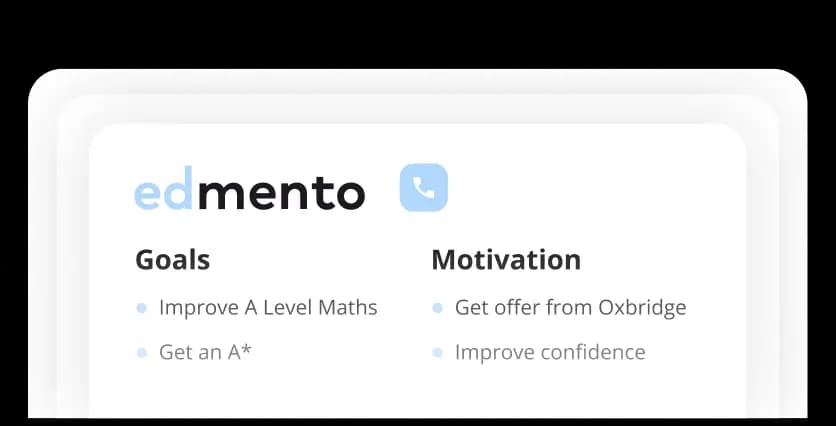
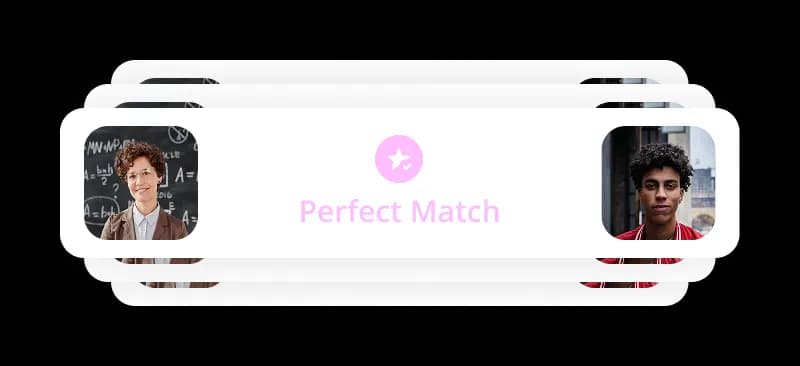
We match by subject, level, exam board, your child's needs and how they learn. Try a lesson before committing.
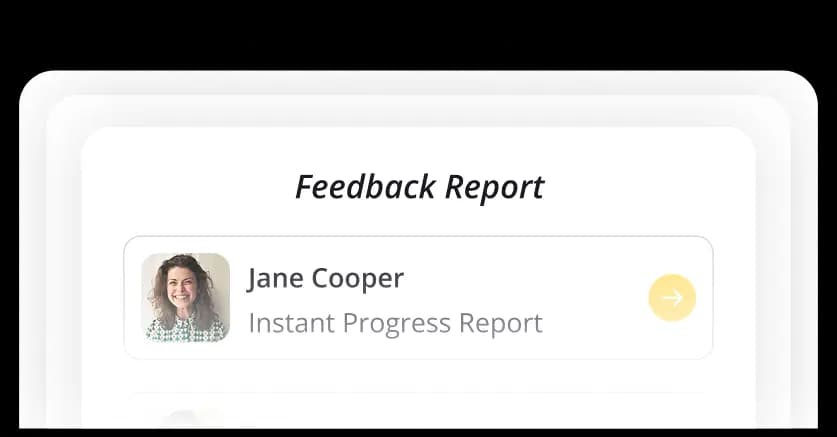
The tutor pinpoints where the working breaks down, from algebra to proof, then fixes the biggest gaps first, with updates for you.
The goal isn't simply to finish the A-Level Maths course.
It's to prepare your child for the grade they're capable of achieving.
Grades E–D
This is where the plan matters most. We rebuild the GCSE foundations A-Level depends on, close the biggest gaps and build steadily towards a secure C.
Grades C–B
We secure the core content, close critical gaps and build confidence with the A-Level questions your child needs to get right.
Grades A–A*
We raise the challenge. Harder questions. Unfamiliar problems. Deeper reasoning. Less hand-holding.
Tell Edmento where things stand and we'll take it from there. Free. No packages to buy. No pressure.
Schools do a lot well, but a teacher has to teach the whole room, and A-Level classes move fast. A tutor only has to teach your child. A Maths tutor can watch exactly where a proof or a calculation goes wrong, whether it's the method, the algebra or a slip, and correct it on the spot.
Slow down on the shaky topics, move on from what's secure.
The questions they'd never ask in a Year 12 class get asked.
Not on what the rest of the set needs that week.
Before a slip becomes a habit that costs marks in every paper.
Whether the problem sheet got done, and whether it stuck.
The tutor sees exactly where a solution goes off track.
At Edmento, lessons start from £15 an hour. Across the UK, the cost of an A-Level Maths tutor depends on the tutor's experience, how much exam preparation is involved and what support comes with the lessons.
1-to-1 lessons cost more than group tuition, but every minute goes on your child's gaps. You won't be asked to buy a large block of lessons before you know the tutor is right: start with the free consultation and a trial.
Fresh. Fierce. Focused.
£15–25
/hour
Yes. Online A-Level Maths tutoring can be as effective as face-to-face when lessons are interactive. Tutor and student write on a shared digital whiteboard, so every line of working is visible, and past-paper questions and proofs are built step by step together.
At Edmento, lessons start from £15 an hour. Across the UK, A-Level Maths tutoring costs vary with the tutor's experience, the level and how much exam preparation and support is included. We start with a free consultation and a trial lesson, with no large upfront package, so you can judge the value before committing.
It usually is when lessons target the specific reasons your child is losing marks. General revision rarely moves a grade on its own; a tutor who diagnoses gaps, sets focused practice and gives feedback on your child's own work can. The trial lesson lets you judge before committing.
Early in Year 12 is ideal, because the step up from GCSE catches many students out and gaps compound quickly. Starting in Year 13 still helps, particularly with exam technique, full past papers and the high-mark questions that decide top grades.
Once a week suits most A-Level students. Some move to twice a week before mocks or the summer exams, or while catching up on a difficult topic. We'll suggest a frequency based on your child's target grade and plans after school.
It can, though no honest tutor guarantees a result. Progress comes from fixing the specific gaps and technique problems that cost marks, practising regularly and getting feedback. We track progress and share updates, so you can see whether it's working.
Usually because the working doesn't show it, or small slips creep in under pressure. Examiners award method marks for clear steps, so a correct method with an arithmetic error can still score, but only if it's written down. A tutor builds the habit of setting out working and checking answers.
By learning a way to start: identifying what's being asked, which topics are involved and what a sensible first step would be. Problem-solving questions reward planning more than speed. A tutor models this on unfamiliar questions, then gradually hands over.
Method marks are awarded for correct steps in the working, even if the final answer is wrong. On longer questions most of the marks can come from method, so clear, well-set-out working is one of the quickest ways to gain marks.
By building checking into how they work: estimating first, writing each step, re-reading the question and substituting answers back where possible. A tutor spots the specific slips your child tends to make and targets those.
Almost never. Difficulty in Maths usually traces back to specific gaps, often from earlier years, and to confidence knocked by repeated mistakes. Once the gaps are found and filled in order, most students find topics start making sense again.
Yes. We ask about your child's exam board during the free assessment and match them with a tutor who knows that specification, its papers and its mark schemes. Not every tutor teaches every board, which is why we match rather than assign.
Lessons happen live, 1-to-1, over video. Tutor and student write on a shared digital whiteboard, so every line of working is visible, and past-paper questions and worked examples are built step by step together. Your child needs a laptop or tablet and a quiet space; many families find it easier than travelling to lessons.
We match on subject, level, exam board, your child's needs and their personality. After the free assessment we suggest a tutor, and your child has a trial lesson so you can both judge the fit before committing.
Yes. You can receive lesson feedback and progress updates, and your Student Success Manager is available whenever you have a question or concern.
Tell your Student Success Manager and we'll find a better match. It happens occasionally, and it's easy to fix.